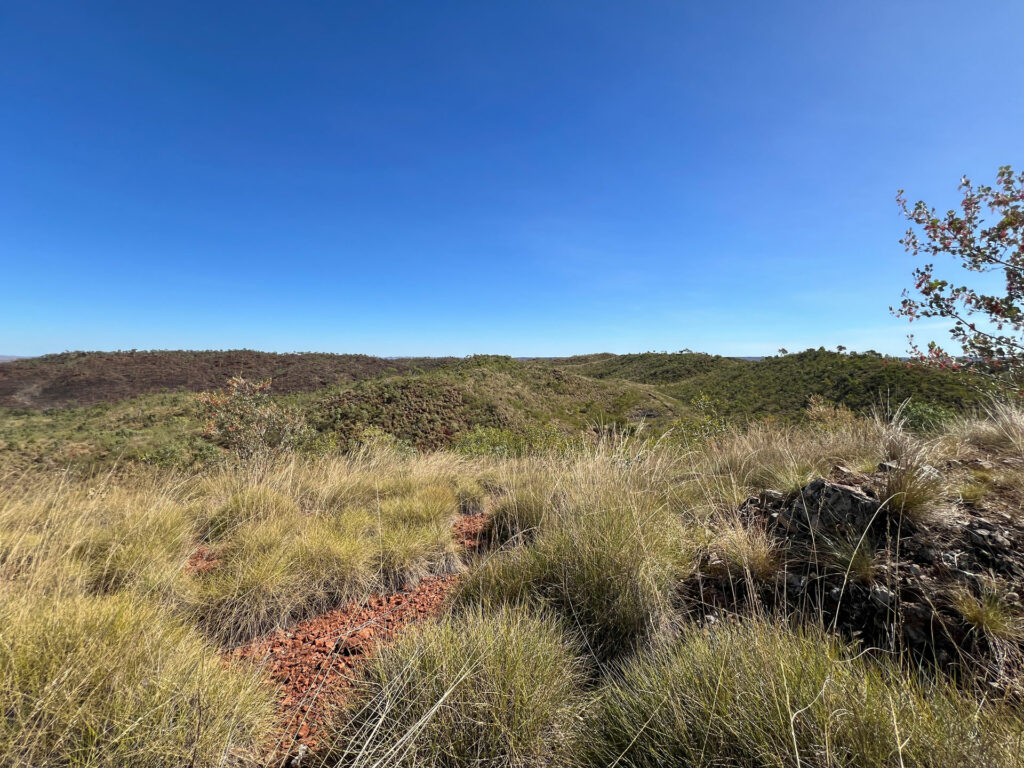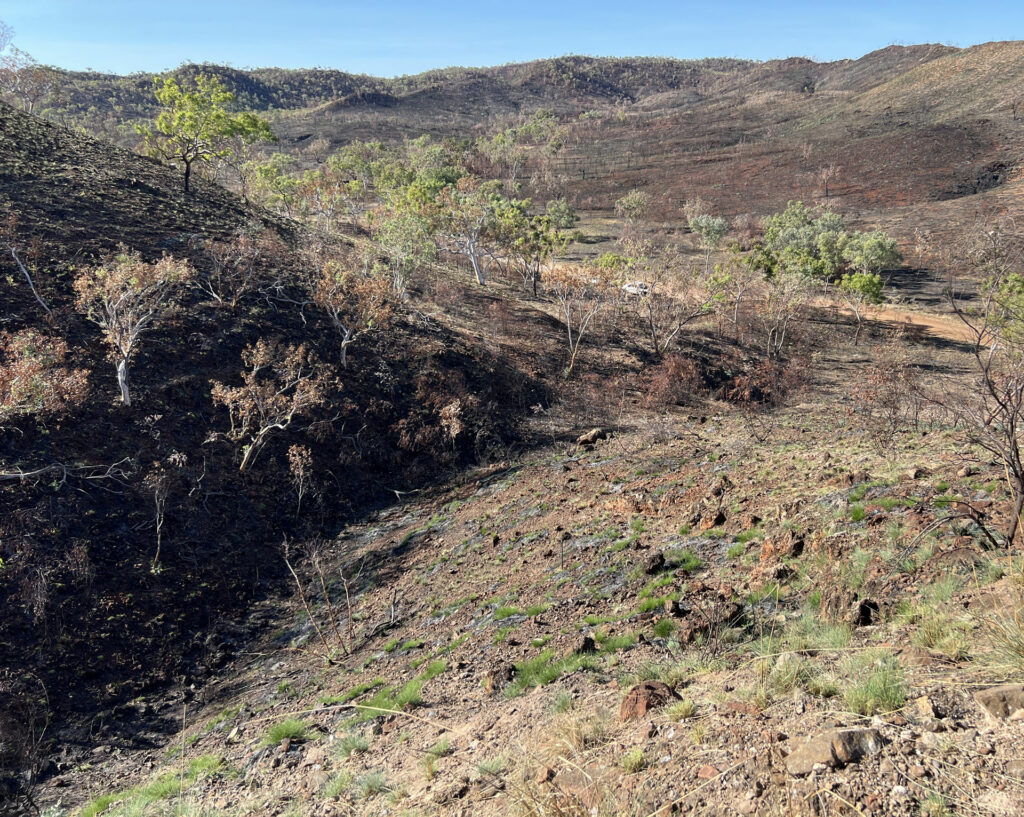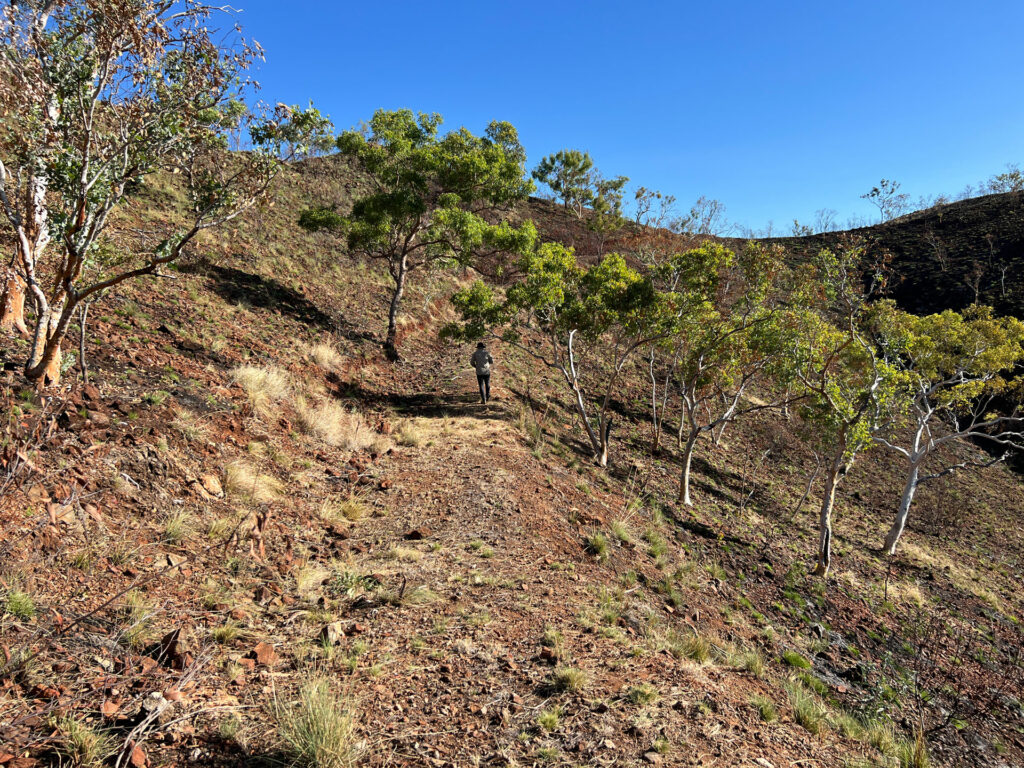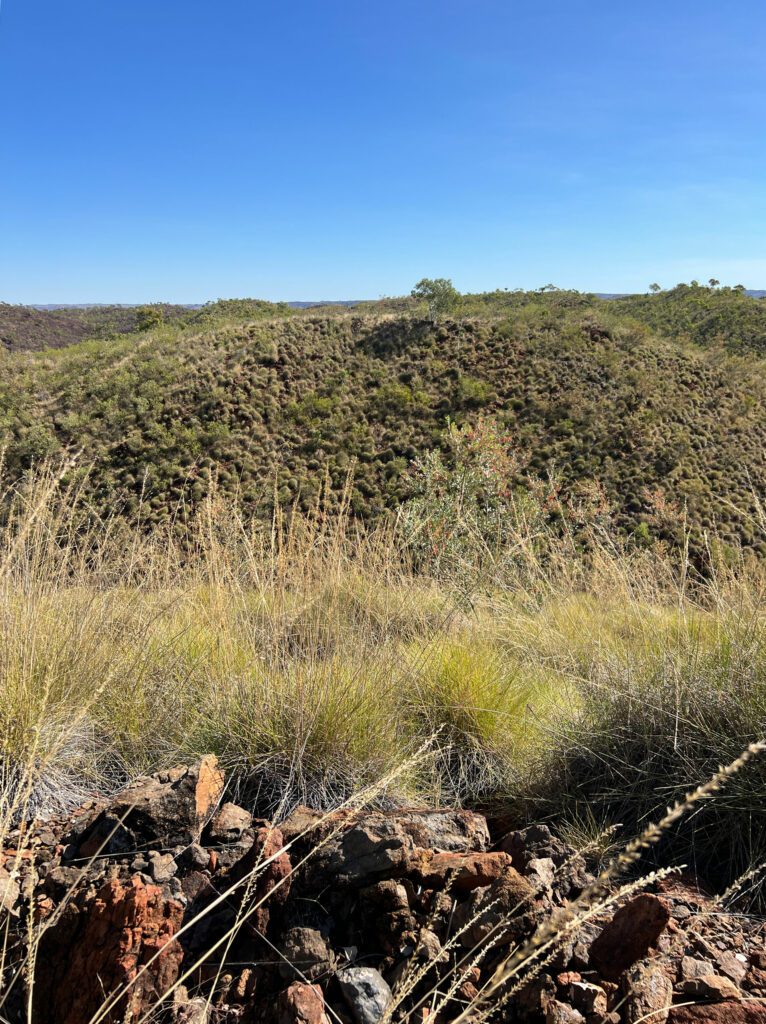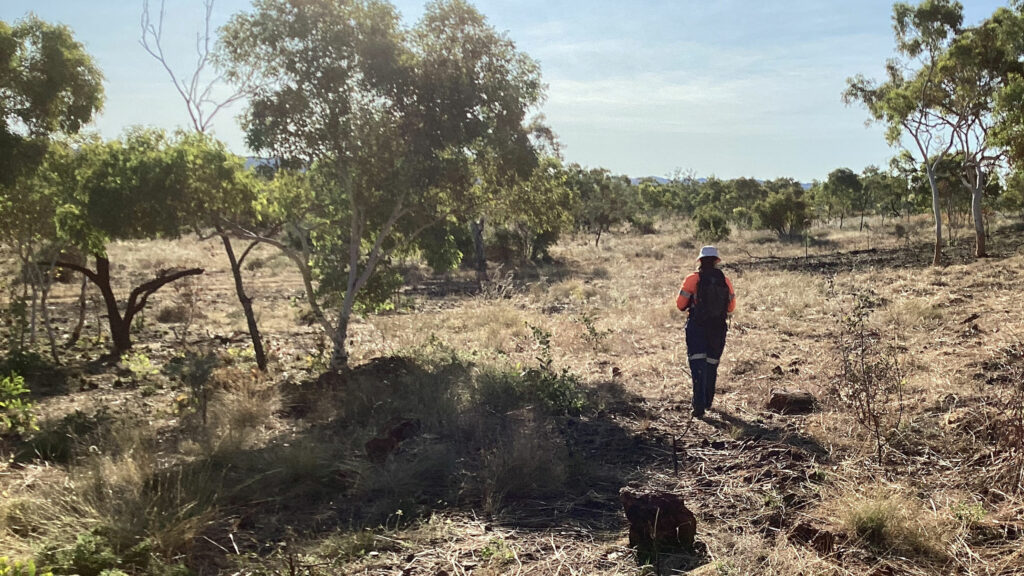






The Alice Downs Corridor lies within a 20 kilometre radius of the Company’s 100% owned Panton PGM Project. It comprises the Eileen Bore and Salk prospects, held 100% by Future Metals, and the Palomino prospect, held under a farm-in and joint venture with Octava Minerals Ltd (ASX: OCT) under which the Company is earning a 70% interest.
Geology
The 18 kilometre long Alice Downs Corridor is characterised by a series of differentiated pyroxenite and gabbroic intrusions emplaced along a structural corridor — the Alice Downs Fault — a major north-northeast trending splay off the deep-seated, mantle-tapping Halls Creek Fault.
Broad zones of disseminated and net-textured copper and nickel sulphides occur within the host intrusions, comprising chalcopyrite, pyrrhotite, pentlandite and pyrite. The previously mined Copernicus deposit, mined by open pit methods by Panoramic Resources Limited intermittently between 2007 and 2016, is one such example and lies within this tract of tenure.
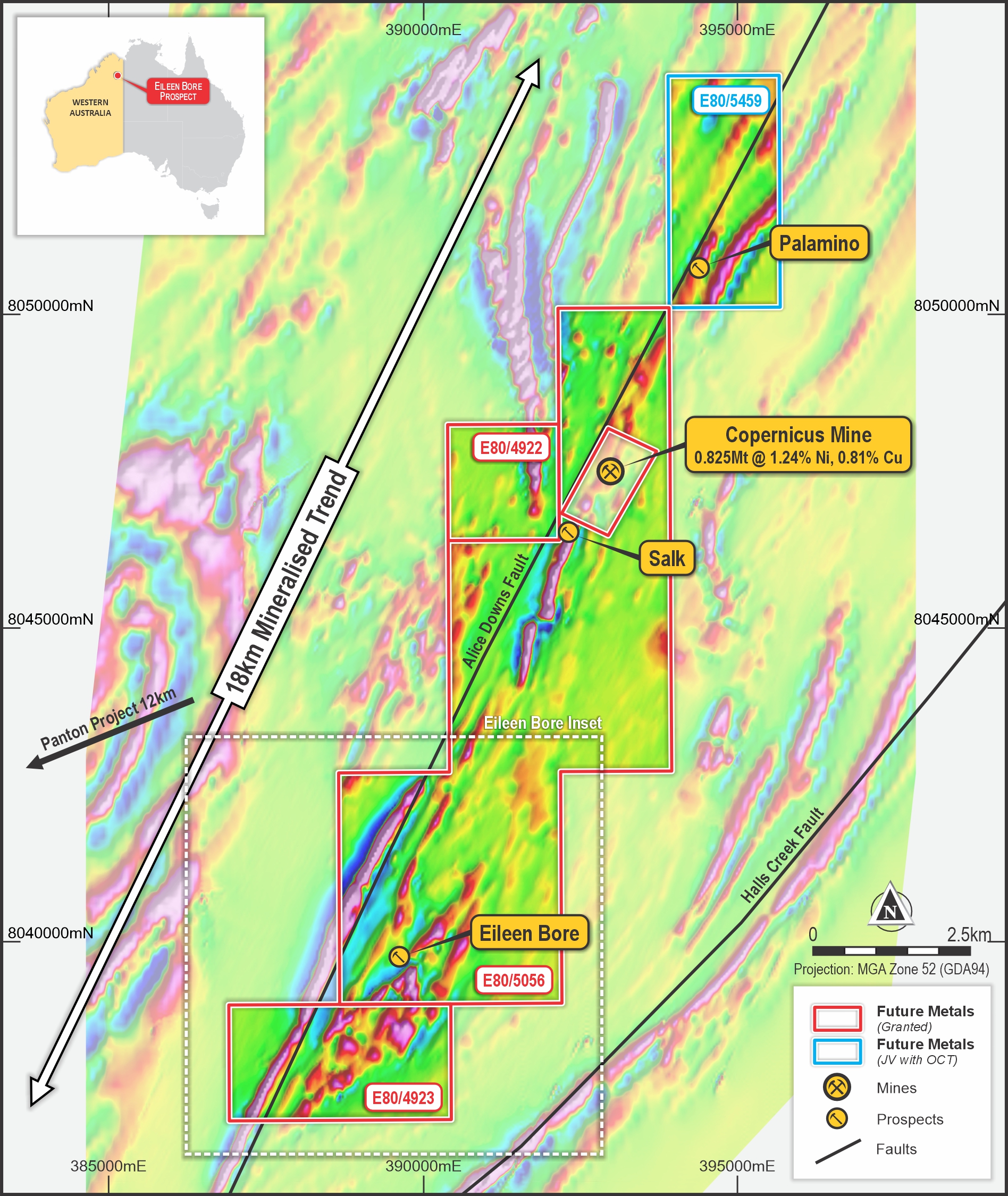
Figure One: Regional overview of the Alice Downs Corridor exploration tenure, showing the principal exploration targets across an 18km strike length, with a magnetic image provided as geological context.
Why the corridor is under-explored
The majority of the project area lies under cover, which has limited the effectiveness of historical surface sampling. There is potential for blind deposits with no surface anomalism.
An extensive exploration dataset exists for parts of the tenement area, including magnetic, gravity, Versatile Time Domain Electromagnetic (VTEM) and Induced Polarisation (IP) surveys, concentrated at the Eileen Bore prospect. The main focus of historical drilling within the Company’s tenure has been near-surface mineralisation at Eileen Bore.
Review of historical drilling, combined with geophysical and structural interpretation, has identified multiple mineralised bodies with a northwest plunge proximal to the Alice Downs Fault. Historical drilling has not effectively tested these targets.
Eileen Bore prospect
Drilling has confirmed wide zones of consistent copper-nickel-PGM mineralisation from surface along a known strike of approximately 300 metres. Mineralisation remains open down plunge and at depth, and has only been tested to 96 metres.
A total of 5,761 metres over 60 holes has been drilled at Eileen Bore. This historical drilling demonstrated a disseminated copper-nickel-PGM magmatic sulphide body within a gabbro-pyroxenite host extending over approximately 300 metres of strike. Multiple holes ended in mineralisation. Modelling suggests mineralisation is focused within a synformal fold axis and plunges to the north-northwest. Drilling down plunge remains open.
Historical drilling results include:
- 120 m at 0.73% Cu, 0.29% Ni and 0.86 g/t PGM 3E from 0 m in hole EBRC 010 (end of hole),
including 16 m at 1.00% Cu, 0.36% Ni and 0.99 g/t PGM 3E from 100 m - 96 m at 0.70% Cu, 0.29% Ni and 0.78 g/t PGM 3E from 24 m in hole EBRC 003 (end of hole),
including 10 m at 1.08% Cu, 0.34% Ni and 1.04 g/t PGM 3E from 56 m - 84 m at 0.54% Cu, 0.24% Ni and 0.75 g/t PGM 3E from 36 m in hole EBRC 011 (end of hole)
- 47 m at 0.62% Cu, 0.30% Ni and 0.60 g/t PGM 3E from 3 m in hole AD07
- 36 m at 0.53% Cu, 0.25% Ni and 0.59 g/t PGM 3E from 40 m in hole EBRC 002
- 64 m at 0.77% Cu and 0.30% Ni from 32 m in hole EP09 (end of hole)
- 52 m at 0.74% Cu and 0.29% Ni from 10 m in hole EP08
Additional targets at Eileen Bore
Two targets lie outside the previously drilled area (Figure 3).
To the northeast, in an antiformal fold axis, Drill Target 2 is based on coincident magmatic chalcopyrite-pyrrhotite mineralisation identified in peridotite rock chips by petrology, associated with nickel-copper, PGE and gold soil anomalism. There is no historical drill testing in that area.
To the south, along the Alice Downs Fault in a synform, Drill Target 3 is associated with the same coincident soil anomalism identified at Eileen Bore and Drill Target 2 and has also not been drill tested.
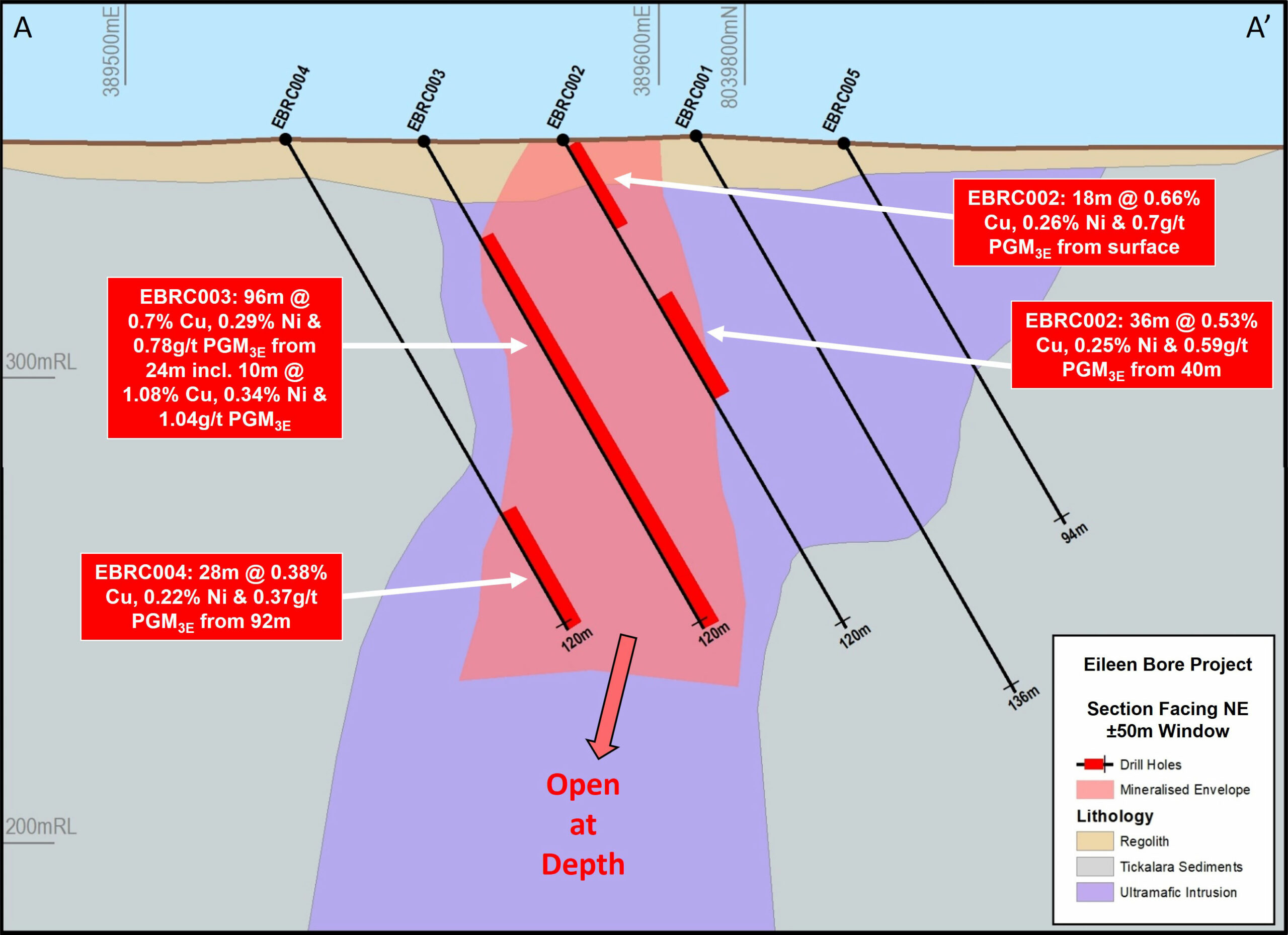
Figure Two: Cross section of drilling at Eileen Bore demonstrating mineralisation open at depth
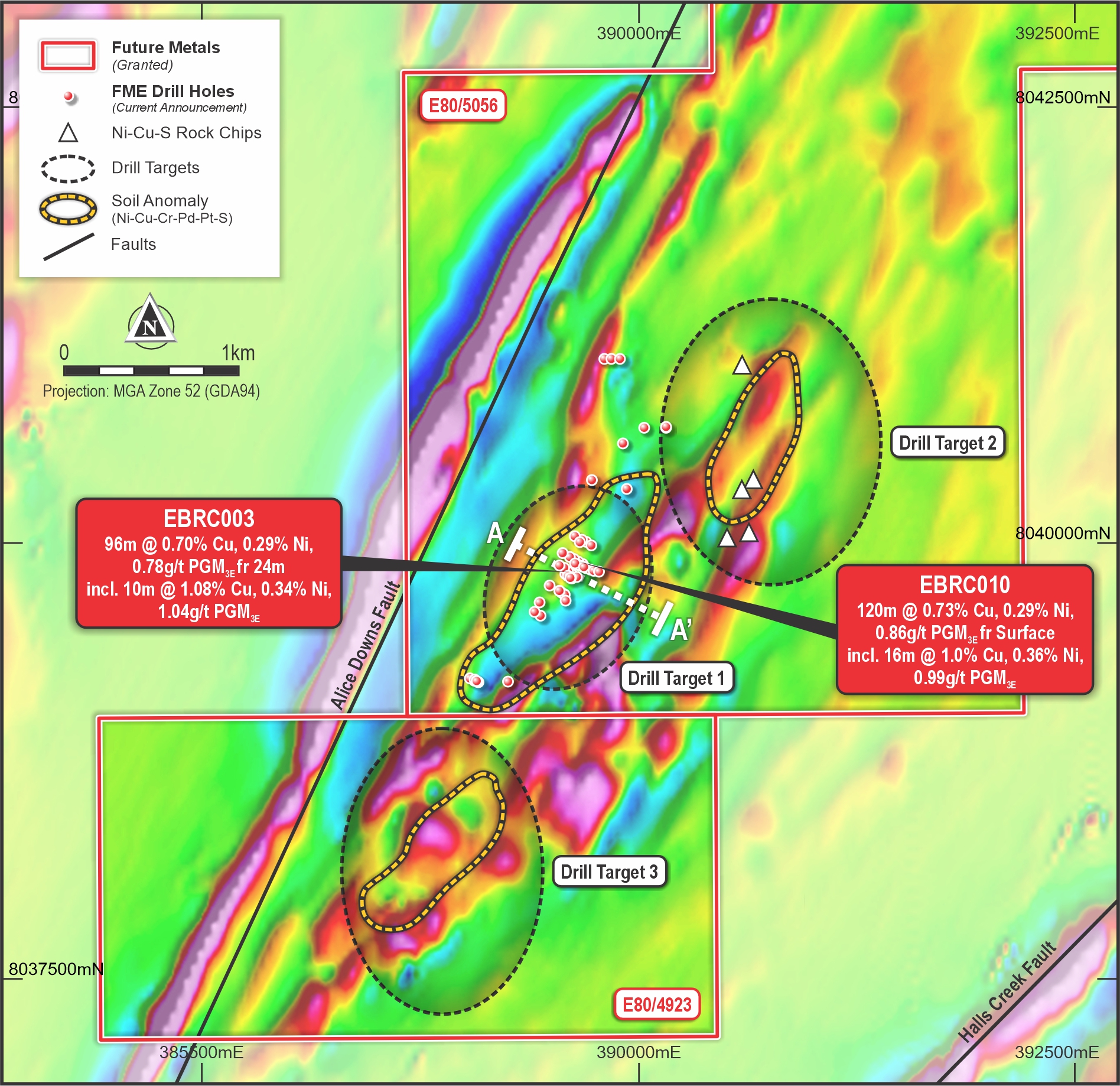
Figure Three: Eileen Bore Prospect show 3 main drill areas: down plunge mineralisation from section A-A’ and Drill Targets 2 and 3
Salk prospect
Salk lies along strike to the north of Eileen Bore, within the same 100% owned exploration tenement. Historical drilling at Salk identified nickel-copper mineralisation in an ultramafic interpreted to be in a fault-offset position from the Copernicus mine. Results included 17 m at 0.31% Ni and 0.18% Cu from 36 m, including 2 m at 0.68% Ni and 0.31% Cu.
The current structural interpretation suggests mineralisation plunges to the northwest. Drilling at Salk has only been undertaken to the south.
Palomino prospect
Palomino lies further along strike to the north, within the farm-in and joint venture with Octava Minerals Ltd (ASX: OCT), under which Future Metals is earning a 70% interest. Historical drilling confirmed a thick pyroxenite body dipping to the northwest that had not previously been mapped. Disseminated sulphides were intersected, with the best result 5 m at 0.39% Ni and 0.32% Cu in hole WCR016.
Exploration and development outcomes are uncertain. The Company reports results as they are received and validated, and will update the market as work progresses.
Photo Gallery