






Panton Mineral Resource Estimate
Announced 9 July 2026
In July 2026 Future Metals NL (‘Future Metals’ or the ‘Company’, ASX : FME) reported an updated JORC (2012) Mineral Resource Estimate for the 100% owned Panton PGM Project in the east Kimberley of Western Australia.
The updated estimate is reported using platinum equivalent (PtEq) grades and is constrained by open pit and underground optimisation studies, so that the Mineral Resource reflects material with reasonable prospects for eventual economic extraction rather than contained metal alone.
The Mineral Resource is approximately 82.3 million tonnes grading 1.6 g/t PtEq (1.3 g/t PGM 3E), 0.19% nickel and 3.0% Cr₂O₃, containing approximately 4.24 million ounces PtEq (3.51 million ounces PGM 3E), 158 kt nickel and 2.5 million tonnes of Cr₂O₃.
Approximately 40.0 million tonnes, containing around 2.06 million ounces PtEq, is classified as Indicated.
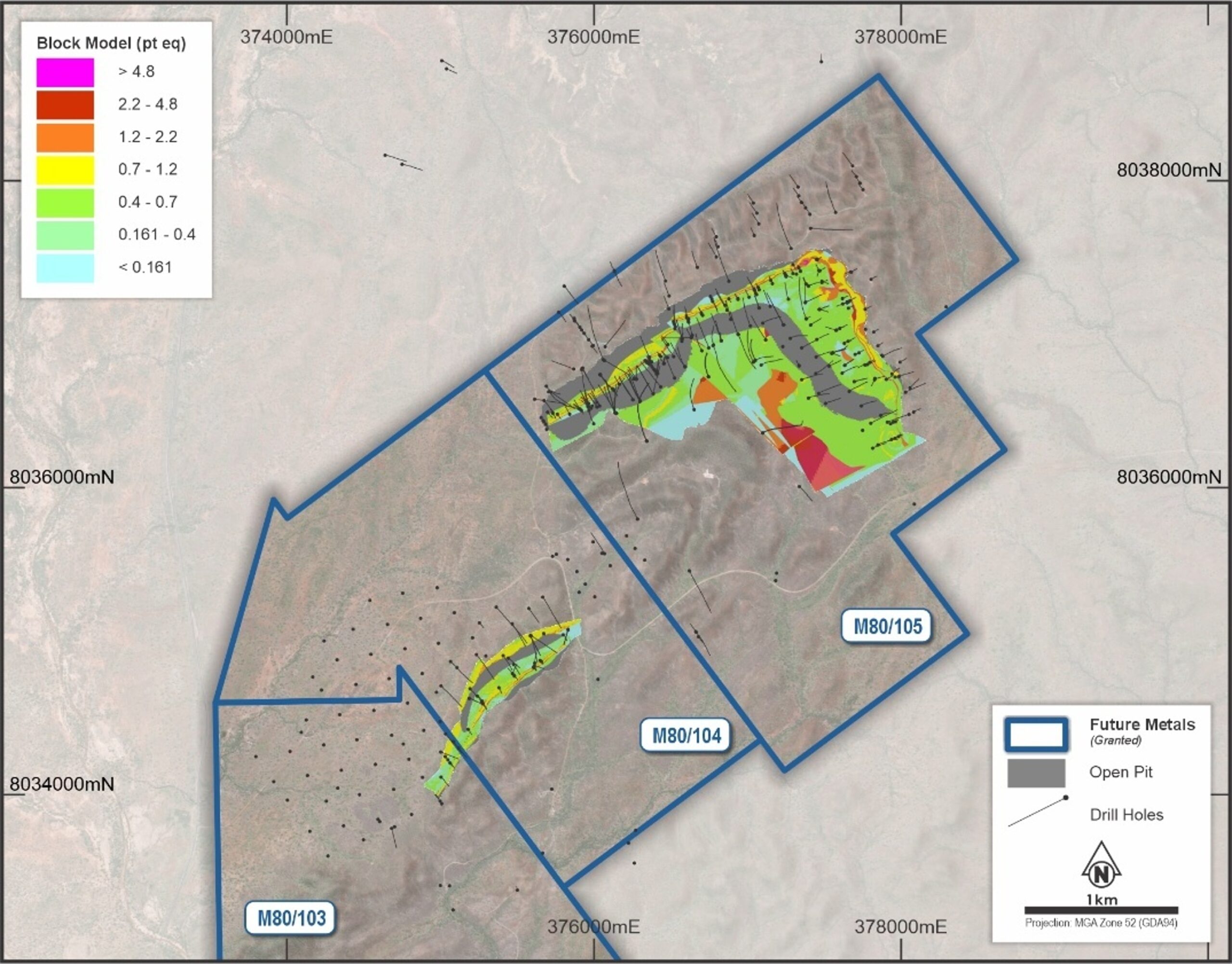
Refer ASX Announcement, 9 July 2026. Mineral Resources are not Ore Reserves and do not have demonstrated economic viability.
What changed, and why it matters
The estimate is reported above NSR-derived cut-offs of A$42.6/t for open pit material and A$140/t for underground material, derived from independent NSR modelling. Open pit material is constrained by a Whittle pit shell at a revenue factor of 1.0; underground material by Mineable Shape Optimiser envelopes below that shell. Unclassified material is treated as waste.
Reporting on this basis means the Mineral Resource describes material that could reasonably be expected to support eventual economic extraction, assessed against modelled revenue rather than grade alone. This is what provides the basis for a new Scoping Study.
Table 1 — Panton PGM Project Mineral Resource Estimate as at 9 July 2026 (RF 1.0, combined scenario)
| Area | Class. | Tonnage (Mt) |
Pt (g/t) |
Pd (g/t) |
Au (g/t) |
Ni (%) |
Cr₂O₃ (%) |
PtEq¹ (g/t) |
PGM3E² (g/t) |
PtEq (Moz) |
PGE3E² (Moz) |
| OPEN PIT — NSR cut-off A$42.6/t, RF = 1.0 | |||||||||||
| OP Total | Indicated | 37.3 | 0.5 | 0.5 | 0.1 | 0.19 | 2.5 | 1.5 | 1.2 | 1.74 | 1.41 |
| OP Total | Inferred | 27.8 | 0.3 | 0.3 | 0.1 | 0.18 | 1.9 | 0.9 | 0.7 | 0.84 | 0.62 |
| OP TOTAL | Total | 65.1 | 0.4 | 0.4 | 0.1 | 0.18 | 2.2 | 1.2 | 1.0 | 2.58 | 2.03 |
| UNDERGROUND MSO — NSR cut-off A$140/t, RF = 1.0 | |||||||||||
| ABC Blocks | Indicated | 2.7 | 1.4 | 1.6 | 0.3 | 0.24 | 7.4 | 3.7 | 3.3 | 0.32 | 0.29 |
| ABC Blocks | Inferred | 14.6 | 1.1 | 1.2 | 0.2 | 0.23 | 5.8 | 2.9 | 2.5 | 1.35 | 1.19 |
| UG TOTAL | Total | 17.2 | 1.1 | 1.3 | 0.2 | 0.23 | 6.1 | 3.0 | 2.7 | 1.66 | 1.48 |
| COMBINED TOTAL (OP + UG), RF = 1.0 | |||||||||||
| Combined | Indicated | 40.0 | 0.6 | 0.6 | 0.1 | 0.19 | 2.8 | 1.6 | 1.3 | 2.06 | 1.70 |
| Combined | Inferred | 42.3 | 0.6 | 0.6 | 0.1 | 0.20 | 3.2 | 1.6 | 1.3 | 2.18 | 1.80 |
| GRAND TOTAL | Total | 82.3 | 0.6 | 0.6 | 0.1 | 0.19 | 3.0 | 1.6 | 1.3 | 4.24 | 3.51 |
¹ PtEq — platinum equivalent. See “Platinum equivalents” below
² PGM3E is Pt(g/t) + Pd(g/t) + Au(g/t)
Notes: Reported in accordance with the JORC Code (2012) at NSR-derived cut-offs of A$42.6/t (open pit) and A$140/t (underground). Open pit material is constrained by a Whittle pit shell at a revenue factor of 1.0; underground material by Mineable Shape Optimiser envelopes below that shell. Unclassified material is treated as waste. Tonnages are reported on a dry basis. Figures are rounded and totals may not sum. Mineral Resources are not Ore Reserves and do not have demonstrated economic viability.
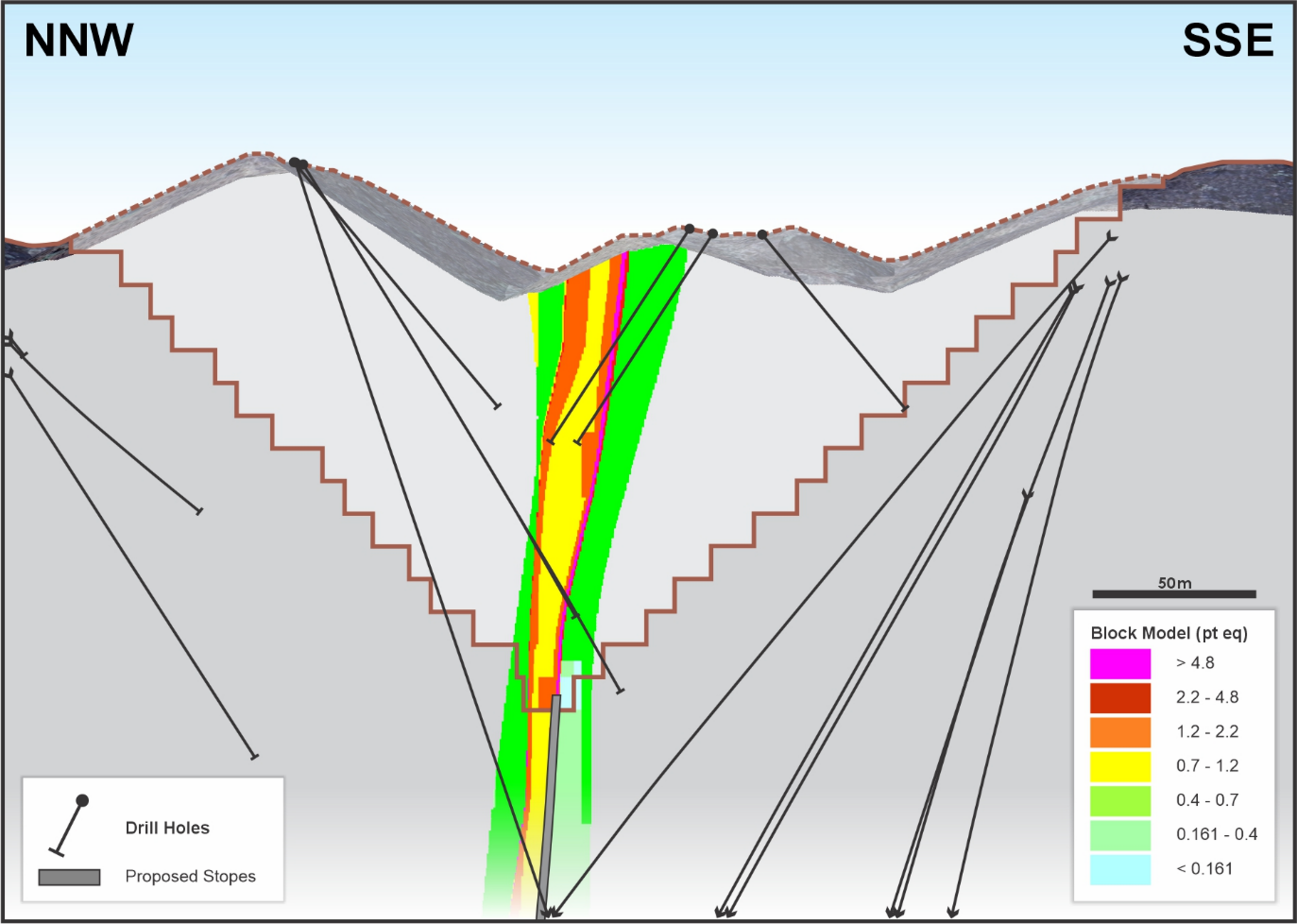
Figure 1: Cross Section C Block with open pit RF1.0 outline & underground stope shapes.
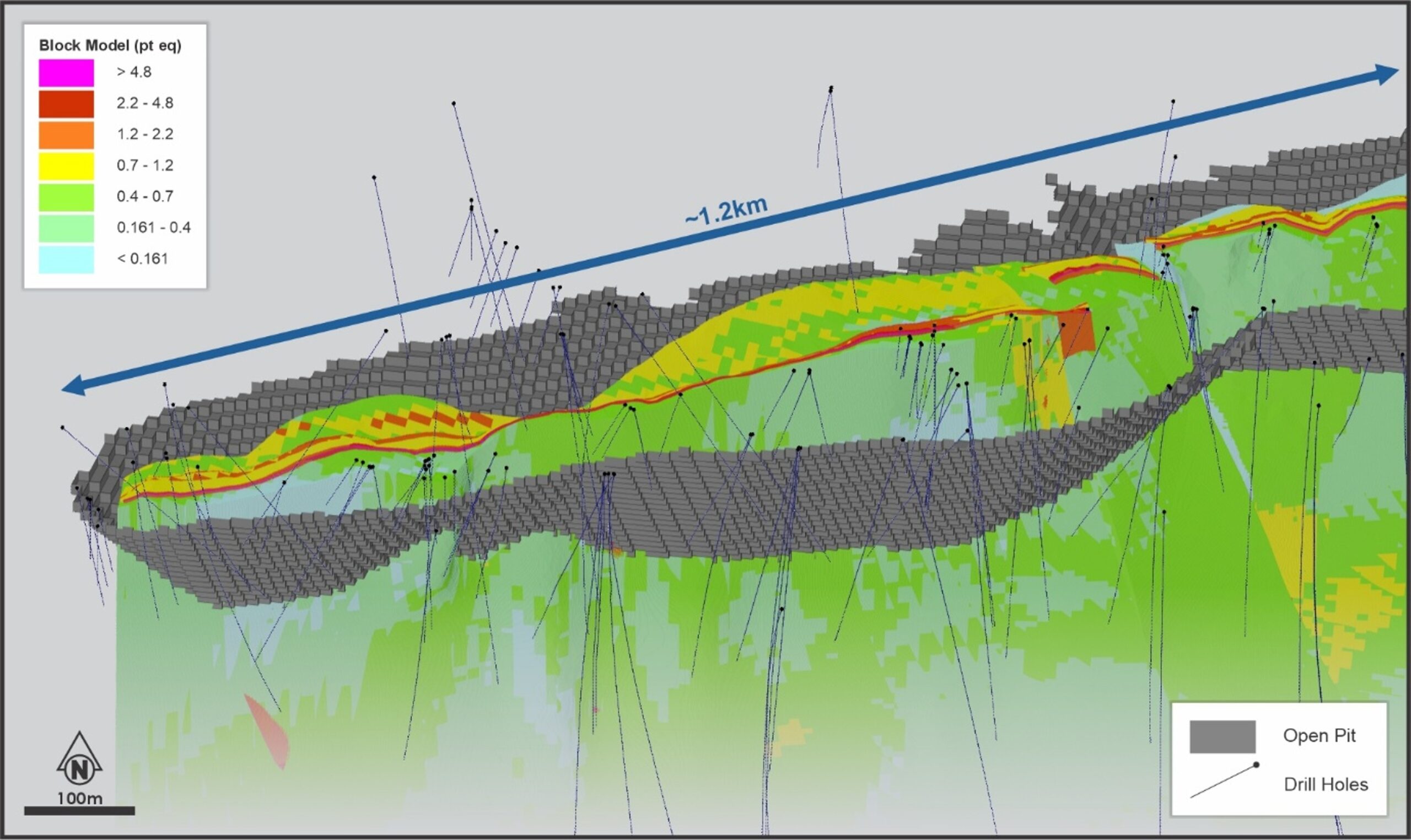
Figure 2: C Block proposed open pit with model coloured by PtEq.
Mineral Resource by material type
The Panton Mineral Resource is reported across two structural blocks — the ABC Zone and D-Block — and by material type within each: the chromite-rich layers known as Reef, the High-Grade Dunite, and the lower-grade Bulk Dunite domains.
Reef
The mineralised chromite layers carry the highest grades. Within the RF 1.0 open pit shell, ABC Zone Reef material totals 3.0 Mt grading 5.7 g/t PtEq. Below the pit, Reef material within the underground shapes totals 4.5 Mt grading 7.3 g/t PtEq, including 0.8 Mt Indicated grading 7.7 g/t PtEq. Across the deposit, Reef accounts for approximately 9% of tonnes but around 38% of contained PtEq ounces.
High-Grade Dunite
The dunite immediately surrounding the Reef forms the bulk of the near-surface high-grade material — 15.2 Mt grading 1.4 g/t PtEq in the ABC open pit and 8.7 Mt grading 1.9 g/t PtEq underground. Combined with the Reef, these two domains total 32.7 Mt for approximately 2.89 Moz PtEq: around 40% of total tonnes carrying approximately 68% of the ounces.
Bulk Dunite
The low-grade dunite domains — outer, inner, upper and mid — make up the remaining approximately 47 Mt grading 0.5 to 0.9 g/t PtEq. This material clears the open pit NSR cut-off but sits well below the Reef in value. The Low Grade Dunite Outer and Upper domains are classified as Inferred, reflecting wider drill spacing and incomplete sampling.
Panton has a high-grade zone within a large lower-grade envelope, typical of a PGM reef-style deposit. The Reef and the High-Grade Dunite are where value concentrates; the Bulk Dunite provides scale that future studies will continue to test.
Detailed Mineral Resource Estimate by structural block and material type: Refer ASX Announcement, 9 July 2026.
Why the infill drilling programme comes next
Infill drilling will target the ABC Block, where 14.6 Mt of the 17.2 Mt underground Mineral Resource is classified as Inferred. The Reef there, grading 7.4 g/t PtEq, is the highest-grade material at Panton and the least classified.
Ore Reserves can only be converted from Indicated and Measured Mineral Resources. While the updated Mineral Resource supports a new Scoping Study, the proportion of Inferred material constrains how far that study can go — a Pre-Feasibility Study or any Ore Reserve estimate requires Indicated Mineral Resources. The infill programme is therefore the Company’s near-term priority.
There is a low level of geological confidence associated with Inferred Mineral Resources, and there can be no certainty that further exploration work will result in the determination of Indicated Mineral Resources.
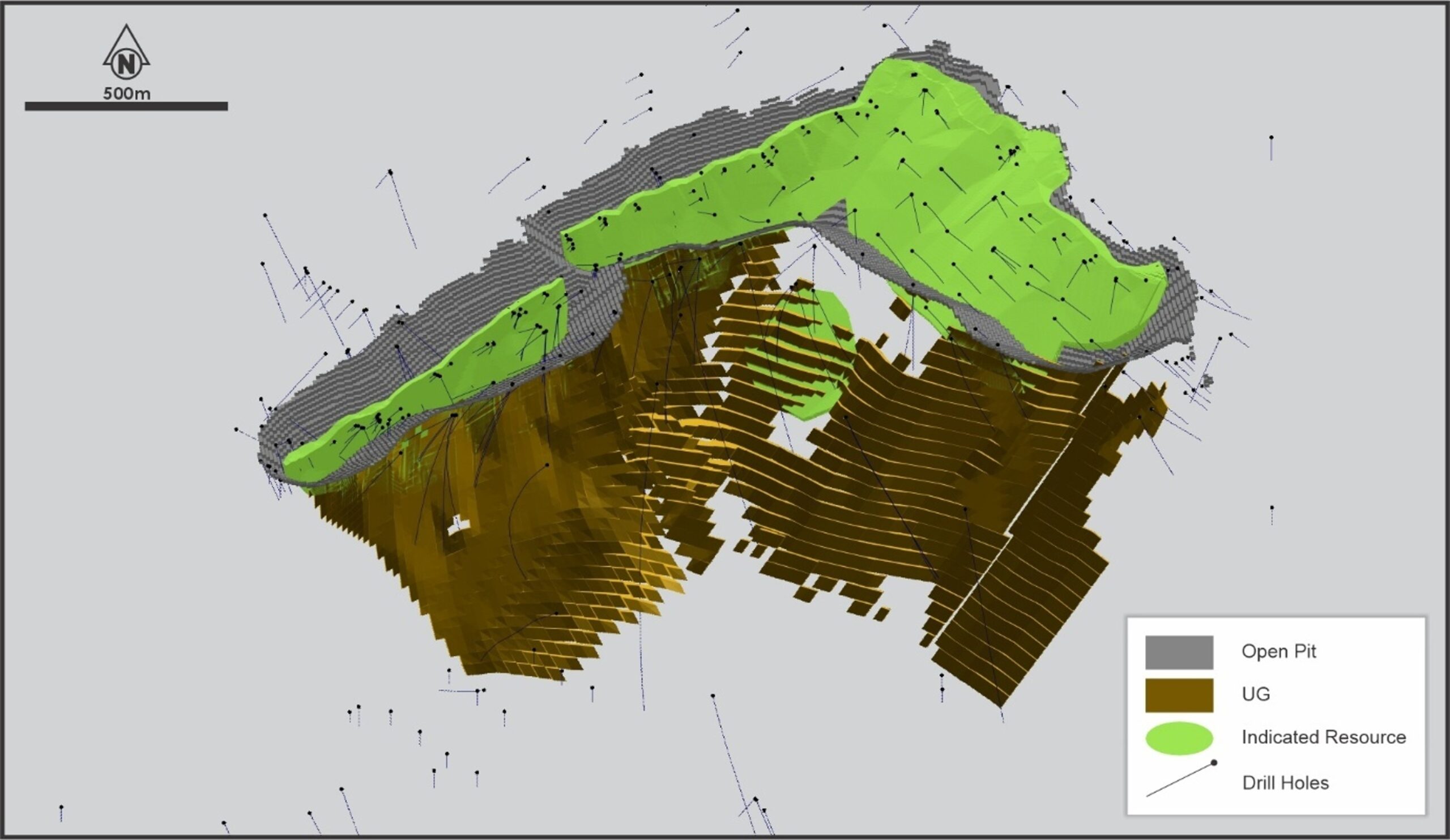
Figure 3: Oblique view of ABC Block RF1.0 open pit and underground MSO shapes, with the block model filtered for the indicated portion of the resource (green), overlain by resource drillholes.
Studies & development pathway
Platinum equivalents
Based on metallurgical test work completed on Panton samples, all elements included in the metal equivalent calculation — platinum, palladium, gold, nickel and chromite — have a reasonable potential of being ultimately recovered and sold. It is the Company’s opinion that all the elements included in the platinum equivalent calculation have a reasonable potential to be recovered and sold.
Metal recoveries used in the PtEq calculation are based on metallurgical test work undertaken to date at Panton.
Table 2: NSR Assumptions: Commodity Prices, Payabilities and Recoveries
| Metal | Price (USD) | Payability | Reef Recovery³ | Dunite Recovery |
| Palladium | US$1,750/oz | 92% | 96.4% | 73.1% |
| Platinum | US$2,300/oz | 92% | 81.9% | 75.6% |
| Gold | US$4,250/oz | 80% | 99.2% | 85.8% |
| Nickel | US$18,100/t | 55% | 42.9% | 35.0% |
| Chromite conc. | US$175/t conc. | 95% | 73% | – |
³Palladium and gold recoveries are inclusive of additional RIL recovery on float tails
The PtEq equivalence factors are derived from the metal price, recovery and payability assumptions used in the NSR calculation, with separate factors for the reef and dunite domains. The values are provided in Table above and formulae as follows.
Formulae:
- Reef: PtEq (g/t) = Pt (g/t) + 0.896 × Pd (g/t) + 2.238 × Au (g/t) + 1.282 × Ni (%) + 0.043 × Cr₂O₃ (%)
- Dunite: PtEq (g/t) = Pt (g/t) + 0.736 × Pd (g/t) + 2.097 × Au (g/t) + 1.133 × Ni (%)
Qualifications:
- No metallurgical test work has been undertaken on recovering a chromite concentrate from dunite, and chromite is therefore excluded from the equivalent calculation for the High-Grade Dunite and Bulk Dunite.
- Copper and cobalt are not included in the PtEq calculation. Continued optimisation of metallurgical performance may warrant their inclusion in subsequent Mineral Resource updates.
- Rhodium, iridium and osmium are not included, due to a paucity of assay data, although flotation test work has demonstrated recovery of these metals. The Company will examine whether resampling of existing drill core for these elements is warranted as it progresses the Project.
- Platinum, palladium and chromite grades reported here are lower than the grades of the samples subject to metallurgical test work. Grades of other elements are similar.
- Metal prices used are based on consensus forecasts of analysts’ estimates. The chromite concentrate price used is a conservative estimate based on historical pricing of South African chrome ore (40 to 42%, CIF China)
Competent Person Statement
The information in this document that relates to Mineral Resources is based on, and fairly represents, information compiled by Mr Brian Wolfe, who is a Member of the Australian Institute of Geoscientists. Mr Wolfe is an external consultant to the Company and is a full-time employee of International Resource Solutions Pty Ltd, a specialist geoscience consultancy. Mr Wolfe has sufficient experience which is relevant to the style of mineralisation and type of deposit under consideration and to the activity he is undertaking to qualify as a competent person as defined in the 2012 Edition of the “Australasian Code for reporting of Exploration Results, Exploration Targets, Mineral Resources and Ore Reserves” (JORC Code). Mr Wolfe consents to the inclusion in this document of the matters based upon his information in the form and context in which it appears.
Future Metals confirms that it is not aware of any new information or data that materially affects the information included in this report and that all material assumptions and technical parameters underpinning the Mineral Resource Estimate for the Panton PGM Project continue to apply and have not materially changed. Future Metals confirms that the form and context in which the Competent Person’s findings are presented have not been materially modified from the original report and that the Competent Person’s consent remains in place for subsequent releases by Future Metals of the same information in the same form and context, until the consent is withdrawn or replaced by a subsequent report or accompanying consent.
View the ASX Announcement 9 July 2026.